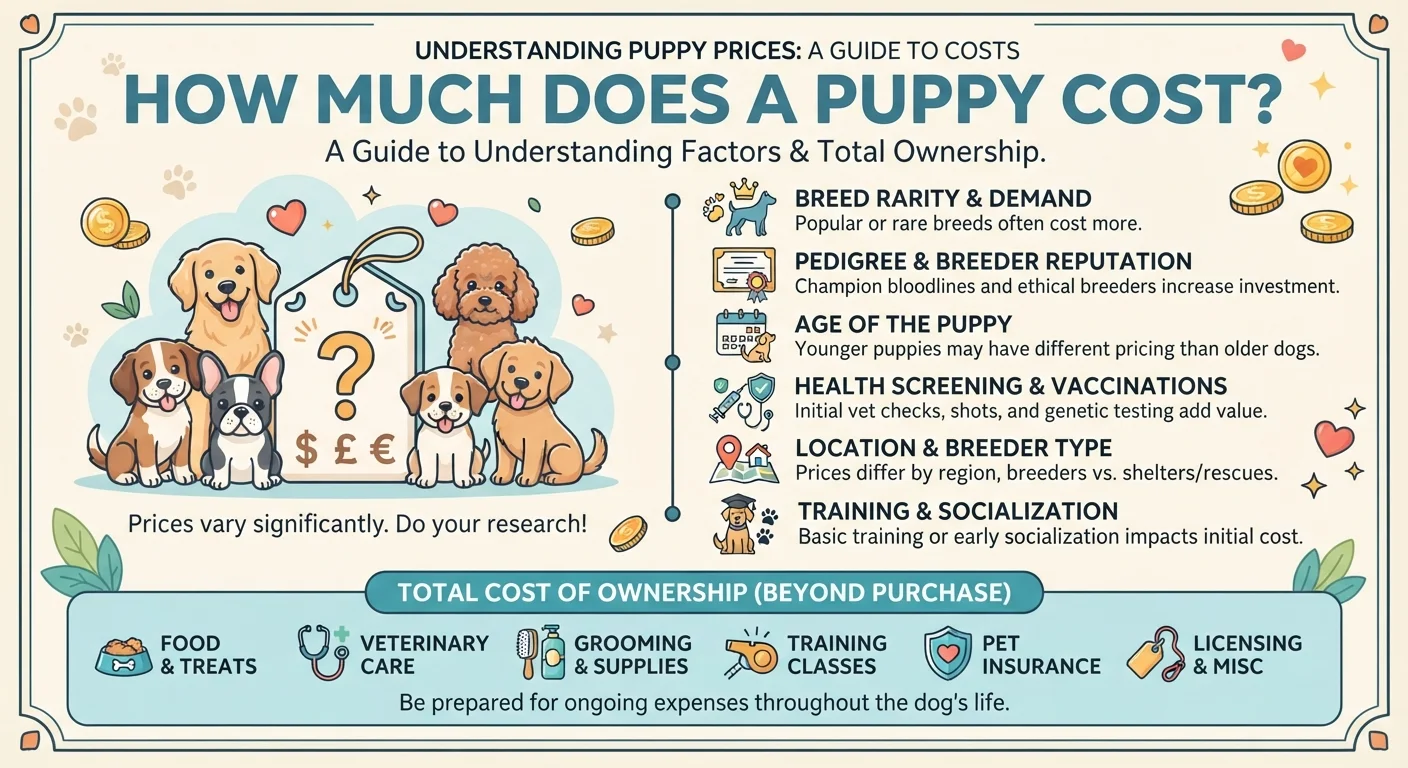
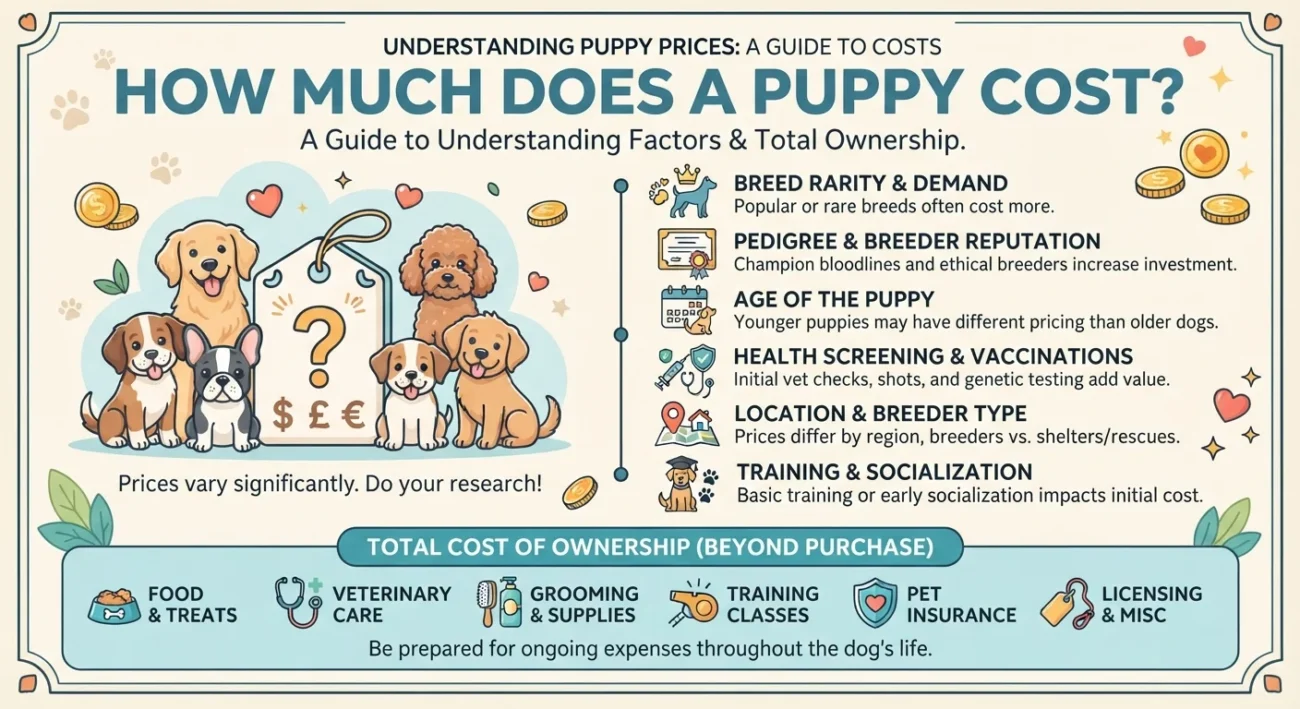
If you are asking, “how much does a puppy cost?” the most important thing to understand is that there is no universal answer. Puppy prices can vary dramatically depending on the breed, age, pedigree, health status, vaccinations, training, location, breeder or seller, and even the time of year.
Two puppies that look similar can have very different prices because their backgrounds, health care, registration status, and upbringing may be completely different. A puppy from a carefully managed breeding program may cost more because the breeder has invested heavily in health testing, veterinary care, appropriate nutrition, socialization, and responsible breeding practices. Another puppy may have a lower purchase price but require significant veterinary care, training, or other expenses after coming home.
This is why looking only at the advertised purchase price can give prospective owners an incomplete picture.
The real question is not simply how much a puppy costs to buy. It is how much it will cost to responsibly care for that puppy throughout its first year and beyond.
Understanding puppy prices can help you create a realistic budget, recognize suspiciously low prices, compare sellers fairly, and avoid making an emotional decision that becomes financially difficult later.
read more about best dog breeds
What Does the Puppy Cost Usually Include?
The purchase price may cover different things depending on the seller.
Some sellers provide puppies that have already received age-appropriate vaccinations, veterinary examinations, parasite prevention, identification, registration documentation, or early socialization. Others may provide very little beyond the puppy itself.
Potential buyers should therefore ask exactly what is included before comparing puppy prices.
A puppy that initially appears more expensive may actually represent better value if important veterinary and care expenses are already covered. Conversely, a low purchase price may not be a bargain if the puppy needs immediate medical treatment or lacks appropriate preventive care.
The price should always be evaluated together with the puppy’s health, background, care, and documentation.
The Main Factors That Determine Puppy Prices
Breed
Breed is one of the most obvious factors influencing puppy cost.
Different dog breeds have different levels of demand, breeding difficulty, litter sizes, availability, and reputation. Popular breeds can attract higher prices because many people want them, while less commonly requested breeds may have different pricing.
Some breeds are also more expensive to responsibly breed because they require specialized health testing, veterinary monitoring, assistance during pregnancy or birth, or other forms of professional care.
The costs associated with maintaining breeding dogs can therefore influence the price of puppies.
It is also important to remember that breed popularity can change. A breed that becomes fashionable may experience increased demand, while interest in another breed may decline.
Age
Age can also influence how much puppies cost.
Very young puppies that are at an appropriate age for placement may be priced differently from older puppies. A puppy that remains with a breeder longer may have received additional food, veterinary care, socialization, training, and other attention.
Older puppies may sometimes be less expensive because buyers tend to prefer younger animals, but this is not a universal rule.
Age should never be the only reason to choose one puppy over another. A slightly older puppy that has received excellent care and early training can be an excellent choice.
Pedigree
Pedigree can significantly affect puppy prices, particularly for recognized breeds.
A pedigree documents ancestry and may be important to buyers interested in showing, breeding, or preserving specific breed characteristics.
However, pedigree does not automatically mean that a puppy is healthier, better behaved, or more suitable for a particular household.
Prospective owners should evaluate the actual health and care of the puppy rather than treating pedigree papers as a guarantee of quality.
Health Testing
Responsible breeding often involves health screening of parent dogs for conditions that may be relevant to the breed.
The specific tests vary from one breed to another.
A breeder who invests in appropriate health testing may have higher costs than someone who breeds dogs without conducting meaningful health evaluations.
This can influence puppy prices.
However, buyers should ask what testing was performed, which parent was tested, and whether documentation is available. A vague claim that the parents are “healthy” is not the same as documented health screening.
Vaccinations
Vaccinations are another factor that can affect the amount a buyer ultimately spends.
Puppies require age-appropriate preventive veterinary care. Depending on their age and location, this may include vaccinations, parasite prevention, examinations, and other routine services.
Some sellers include certain veterinary services in the purchase price. Others leave these costs to the new owner.
When comparing puppies, ask what vaccinations have already been administered and whether veterinary records are provided.
Veterinary Examinations
A responsible seller may have puppies examined by a veterinarian before they leave for their new homes.
Veterinary examinations can help identify obvious health problems and provide an opportunity to establish a basic medical record.
The cost of veterinary care contributes to the overall expense of raising puppies, which can affect puppy prices.
However, even a veterinary examination cannot guarantee that a puppy will never develop a health condition later in life.
Early Training
Some puppies receive basic training before they are sold.
This may include exposure to household sounds, gentle handling, crate introduction, basic routines, appropriate elimination habits, and early socialization.
More advanced training can increase the puppy cost because it requires time and professional expertise.
A trained puppy may save the new owner time, but buyers should still expect to continue training after bringing the puppy home.
Socialization
Early socialization is another important investment.
Well-managed puppies can be gradually exposed to appropriate people, household sounds, surfaces, routines, and environments in ways suitable for their age.
Socialization can contribute to a puppy’s ability to adapt to new experiences.
Because responsible socialization requires time and planning, it can also influence the cost of raising puppies.
Why Puppy Prices Can Be So Different
Supply and Demand
Basic economics plays a role in puppy prices.
When demand for a particular breed is high and the supply of responsibly bred puppies is limited, prices may increase.
However, high demand can also encourage irresponsible breeding and dishonest sellers.
A high price should therefore never be interpreted automatically as proof that a seller is responsible.
Breeding Costs
Responsible breeding involves much more than putting two dogs together.
Costs may include food, veterinary examinations, health testing, vaccinations, parasite prevention, reproductive care, emergency veterinary treatment, housing, cleaning, socialization, and time.
Pregnancy and birth can sometimes involve unexpected complications that require urgent veterinary attention.
These expenses can be reflected in puppy prices.
Litter Size
The number of puppies in a litter can affect the economics of breeding.
A large litter may spread some costs across more puppies, while a small litter may involve similar pregnancy and veterinary expenses divided among fewer animals.
Some breeds naturally tend to have smaller or larger litters.
Location
Location is another major factor in puppy prices.
The cost of veterinary services, housing, food, labor, transportation, and general living expenses varies between cities and countries.
Demand can also differ dramatically between regions.
A breed that is common in one area may be difficult to find in another.
Season and Market Conditions
Puppy demand can change throughout the year.
Certain holidays, school breaks, or periods when families have more free time can influence demand.
Market trends can also affect prices.
This is one reason it is better to understand the factors behind puppy prices rather than relying on a single price example found online.
How Much Are Puppies From Different Sources?
Responsible Breeders
A responsible breeder may charge more than an informal seller because of the investment required to raise puppies appropriately.
Potential costs can include health testing, veterinary care, nutrition, safe housing, socialization, and breed-specific care.
However, price alone is not enough to determine whether a breeder is responsible.
Buyers should look at how the puppies are raised, whether the mother can be seen when appropriate, what health information is available, and whether the seller is willing to answer detailed questions.
Animal Shelters and Rescue Organizations
Adoption fees are often structured differently from breeder puppy prices.
A shelter or rescue organization may include certain veterinary services, vaccinations, identification, sterilization where age-appropriate, or other care in its adoption fee.
The exact amount varies by organization, location, age, and individual animal.
Adoption can provide an alternative to purchasing from a breeder while giving a dog an opportunity to find a permanent home.
Private Sellers
Private sellers may advertise puppies at a wide range of prices.
The challenge is that the quality of care can vary considerably.
A low price does not necessarily mean a puppy is unhealthy, but buyers should be particularly careful when there is little information about the puppy’s history, veterinary care, parents, or living conditions.
Online Sellers
Online listings can make it easy to compare puppy prices, but they also require caution.
Photographs and attractive descriptions do not prove that a seller is responsible.
Potential buyers should verify information, ask questions, and avoid making a decision based solely on a low price or an appealing picture.
read more about best puppies for families
The Difference Between Purchase Price and Puppy Cost
The First-Year Budget
The purchase price is only one part of the cost of owning a puppy.
During the first year, owners may need to budget for:
- Veterinary examinations
- Vaccinations
- Parasite prevention
- Food
- Bowls
- Collar and identification
- Leash and harness
- Crate or sleeping area
- Bedding
- Toys
- Grooming
- Training
- Identification or registration where applicable
- Pet-proofing supplies
- Cleaning products
- Emergency veterinary care
- Boarding or pet care when necessary
The total can be significantly higher than the original puppy price.
This is why prospective owners should calculate the first-year budget before bringing a puppy home.
Recurring Expenses
Some costs continue throughout the dog’s life.
Food is an ongoing expense, as are routine veterinary visits and preventive care.
Depending on the breed, grooming may also be a regular cost.
Training, boarding, insurance where available, medication, dental care, and other services can add to annual expenses.
The long-term commitment can therefore be much more important financially than the initial puppy cost.
Food Costs and Puppy Prices
Choosing Appropriate Food
Puppies have nutritional needs that differ from adult dogs.
The appropriate diet depends on factors such as breed size, age, growth rate, health, and veterinary recommendations.
Food costs can vary significantly.
Large-breed puppies may consume more food as they grow, while smaller breeds generally require less.
Owners should not choose the cheapest food automatically. At the same time, expensive food is not automatically the best option.
A veterinarian can help owners select an appropriate diet.
Treats and Supplements
Training treats can become a recurring expense.
Some owners also purchase supplements, but supplements should not be given routinely without a good reason or professional advice.
A balanced diet appropriate for the puppy’s life stage is generally the foundation of nutrition.
Veterinary Costs Beyond Vaccinations
Routine Preventive Care
Routine veterinary care is essential.
Puppies need appropriate examinations and preventive health care based on age, location, lifestyle, and veterinary recommendations.
Preventive care may help identify problems before they become more serious.
Parasite Prevention
Parasites can affect puppies and may include internal parasites as well as external parasites.
The appropriate prevention strategy depends on the puppy and local risks.
Owners should follow veterinary guidance rather than choosing medications randomly.
Unexpected Medical Problems
One of the most important financial considerations is unexpected veterinary care.
A puppy can become sick or injured even when the owner provides excellent care.
Emergency treatment can be expensive, and costs may rise quickly when diagnostic tests, hospitalization, surgery, or specialized treatment are required.
An emergency fund can therefore be an important part of responsible puppy ownership.
Training and Its Effect on Total Puppy Cost
Why Training Matters
Training is not simply about teaching tricks.
It helps puppies understand household expectations and can support safer, more manageable behavior.
Basic training may include name recognition, recall, leash skills, appropriate elimination habits, calm behavior, and basic cues.
Training can reduce future behavioral problems and improve communication between the dog and its owner.
Professional Training
Some owners choose private trainers, group classes, or specialized programs.
Professional training adds to the cost of owning a puppy, but it can be a valuable investment.
The appropriate option depends on the puppy’s behavior, the owner’s experience, and the goals of the household.
Training at Home
Owners can also teach many basic behaviors at home.
This requires consistency, patience, appropriate rewards, and an understanding of how puppies learn.
Even when owners train at home, professional guidance can be helpful when behavioral problems become difficult to manage.
Grooming and Breed-Specific Costs
Short-Coated Breeds
Some dogs have relatively simple grooming requirements.
Owners may be able to handle much of the routine grooming at home with appropriate brushing and bathing.
However, all dogs still require basic hygiene and routine care.
Long-Coated Breeds
Dogs with long, curly, or continuously growing coats may require more frequent grooming.
Professional grooming can become a significant recurring expense.
Potential buyers should research the grooming requirements of a breed before deciding that the initial puppy price fits their budget.
Nail, Ear, and Dental Care
Grooming costs can also include nail care, ear care, bathing, brushing, and dental hygiene.
Some owners handle these tasks themselves, while others use professional services.
Breed and individual health can influence how much care is required.
read more about best dogs for apartments
How Location Changes Puppy Prices
Urban Areas
Puppy prices can be higher in areas where demand and living costs are high.
Veterinary care, professional services, and boarding may also cost more.
Rural Areas
Prices can be different in rural locations due to supply, demand, and local economic conditions.
However, buyers should not assume that rural puppies are automatically cheaper or better value.
Transportation and access to veterinary services should also be considered.
Regional Breed Availability
Some breeds are more common in particular regions.
A breed that is difficult to find locally may cost more because transportation and specialized breeding programs can add expenses.
How to Evaluate a Puppy Seller
Ask Detailed Questions
A responsible seller should be willing to discuss the puppy’s background.
Questions may include:
- How old is the puppy?
- What veterinary care has the puppy received?
- Which vaccinations have been administered?
- Has the puppy received parasite prevention?
- Can you provide veterinary records?
- What is known about the parents?
- What health testing was performed?
- How were the puppies raised?
- What socialization have they received?
- What food are they currently eating?
- What happens if the puppy develops a health problem shortly after purchase?
The answers can reveal more than the advertised price.
Observe the Living Environment
When possible and appropriate, buyers should see where puppies are raised.
The environment should appear clean, safe, and suitable for the animals.
Puppies should generally appear alert, active, and appropriately social for their age.
Potential buyers should also pay attention to the condition and behavior of the mother.
Beware of Pressure
A seller who pressures you to make an immediate payment should raise concerns.
Responsible decisions should not require rushing.
Be particularly cautious when a seller refuses reasonable questions, avoids showing where puppies are raised, provides inconsistent information, or insists on payment before providing basic details.
Warning Signs of an Unusually Low Puppy Price
Why Cheap Is Not Always Better
A very low puppy price may appear attractive, especially to someone working with a limited budget.
However, the lower purchase price may be associated with missing veterinary care, inadequate nutrition, poor breeding practices, lack of socialization, or other problems.
This does not mean every inexpensive puppy is unhealthy.
It means buyers should investigate why the price is low.
Missing Health Records
If a seller cannot provide reasonable information about vaccinations, veterinary examinations, parasite prevention, or the puppy’s medical history, the buyer may face additional expenses after purchase.
Missing records can also make it more difficult for a veterinarian to determine what care the puppy needs next.
Poor Living Conditions
Dirty, overcrowded, unsafe, or visibly unhealthy environments should be treated as serious warning signs.
A cheap puppy is not a bargain if purchasing it supports harmful breeding practices or leads to significant medical and behavioral problems.
Warning Signs of an Extremely Expensive Puppy
High Price Does Not Guarantee Quality
The opposite problem also exists.
A seller may charge an extremely high price because a particular breed is fashionable or because the puppy is marketed as rare or exclusive.
High puppy prices do not automatically prove that the breeder conducts health testing or provides excellent care.
Buyers should evaluate evidence rather than marketing language.
Question Claims About Rarity
Terms such as “rare,” “exclusive,” or “luxury” can be used to justify high prices.
Ask what specifically makes the puppy different.
If the answer is simply that the color or appearance is unusual, buyers should investigate whether the characteristic is associated with health concerns or unethical breeding practices.
Questions to Ask Before Buying a Puppy
Questions About Health
Ask for clear information about veterinary care, vaccinations, parasite prevention, health screening, and any known medical issues.
Do not be afraid to request documentation.
Questions About Parents
Understanding the parents can provide useful information about the puppy’s background.
Ask about their age, health, temperament, and relevant breed-specific health testing.
Questions About Behavior
Ask how the puppies have been socialized.
Have they experienced normal household sounds? Have they been handled appropriately? Have they been exposed to different people and environments in an age-appropriate way?
Questions About the Contract
If a seller uses a written agreement, read it carefully before paying.
The contract may contain information about health guarantees, registration, return policies, breeding restrictions, or responsibilities of the buyer.
If something is unclear, ask for an explanation before signing.
How to Compare Puppy Prices Fairly
Compare What Is Included
Do not compare two advertised numbers without understanding what each includes.
One puppy may have received several veterinary services while another may not.
One seller may provide extensive documentation and early socialization while another provides almost none.
The advertised price is therefore only the starting point for comparison.
Compare the Quality of Care
Consider the environment, nutrition, veterinary care, breeding practices, socialization, and transparency of the seller.
A responsible seller should be able to explain the puppy’s background.
Compare Long-Term Risk
A lower initial price can become more expensive if the puppy develops preventable or inherited problems related to irresponsible breeding.
This does not mean every health problem can be predicted or prevented.
It means responsible breeding and appropriate veterinary care can be important factors when assessing the overall value of a puppy.
Preparing Your Home Before the Puppy Arrives
Puppy-Proofing
Puppies are curious and can chew, swallow, climb, and explore dangerous areas.
Before arrival, remove accessible toxic substances, secure electrical cords, block unsafe spaces, and keep small objects away from the puppy.
Puppy-proofing can prevent injuries and reduce unexpected veterinary expenses.
Basic Supplies
A new puppy generally needs several basic supplies.
These can include food and water bowls, appropriate food, a collar or harness, identification, a leash, a sleeping area, toys, cleaning supplies, and grooming tools.
The exact list depends on the puppy’s size, breed, age, and household.
Creating a Routine
Puppies benefit from predictable routines.
Establish regular times for feeding, toilet breaks, rest, exercise, training, and sleep.
A consistent routine can make the transition easier for both the puppy and the family.
The Emotional Cost of Owning a Puppy
Time Is Also a Resource
Money is only one part of puppy ownership.
Puppies require significant time.
They need supervision, training, socialization, exercise appropriate to their age, veterinary appointments, feeding, cleaning, and companionship.
A person who can afford a puppy financially but cannot provide enough time may still not be ready for one.
Patience and Commitment
Puppies can be messy and unpredictable.
Accidents in the home, chewing, barking, interrupted sleep, and training challenges are common parts of early puppyhood.
Owners should be prepared for a learning period rather than expecting a perfectly behaved dog immediately.
How to Build a Realistic Puppy Budget
Separate One-Time and Recurring Costs
A useful budget divides expenses into two categories.
One-time expenses may include the puppy purchase or adoption fee, crate, initial supplies, and certain setup costs.
Recurring expenses may include food, veterinary prevention, grooming, training, toys, boarding, and other services.
This makes it easier to understand the real financial commitment.
Create an Emergency Fund
Even a carefully planned budget cannot predict every medical problem.
Setting aside money specifically for unexpected veterinary care can make emergencies less financially stressful.
The appropriate amount depends on personal circumstances, local veterinary costs, and the dog’s needs.
Consider Insurance Where Available
Pet insurance is available in some markets and can help cover certain eligible veterinary expenses depending on the policy.
Policies vary considerably, including exclusions, deductibles, waiting periods, reimbursement structures, and coverage limits.
Anyone considering insurance should carefully read the policy before purchasing it.
read more about small dogs for sale
Are Puppies More Expensive Than Adult Dogs?
Comparing Puppy and Adult Dog Costs
Puppies can involve significant initial costs because they require foundational veterinary care, training, supplies, and socialization.
Adult dogs may already have some training and established routines.
However, adult dogs can also have their own veterinary or behavioral needs.
The better choice depends on the owner’s lifestyle, experience, available time, and expectations.
Adoption as an Alternative
People who are flexible about age may consider adopting an adult dog.
An adult dog can sometimes provide a clearer picture of temperament and personality.
Adoption fees and included services vary by organization, so potential owners should ask what veterinary care and other services are included.
How Breed Characteristics Affect Long-Term Costs
Large Dogs
Large dogs generally require more food and may need larger beds, crates, collars, harnesses, and other equipment.
Some large breeds may also have breed-specific health considerations.
Potential owners should consider these factors before focusing only on the initial puppy price.
Small Dogs
Small dogs may consume less food and require smaller equipment, but they are not automatically inexpensive to own.
Veterinary care, grooming, dental care, training, and other expenses still apply.
High-Maintenance Breeds
Some breeds require substantial grooming, specialized exercise, extensive training, or particular environmental conditions.
Researching these requirements before purchase can prevent financial surprises.
Responsible Puppy Ownership
Think Beyond the Purchase
A puppy is a living animal, not a short-term purchase.
Responsible ownership means being prepared to provide food, veterinary care, training, companionship, exercise, appropriate housing, and attention throughout the dog’s life.
The purchase price may be paid once, but the responsibility continues for many years.
Choose Based on Compatibility
A puppy should not be selected solely because it is attractive, trendy, or inexpensive.
Consider the breed’s energy level, adult size, grooming needs, temperament, exercise requirements, and typical lifestyle.
Choosing a dog that fits your household can reduce future behavioral and practical challenges.
Frequently Asked Questions About Puppy Prices
How Much Does a Puppy Cost?
There is no single puppy cost that applies everywhere. Puppy prices vary according to breed, pedigree, health care, vaccinations, training, location, demand, seller, and what is included in the purchase.
Rather than relying on a fixed number that may quickly become outdated, compare the puppy’s background, care, documentation, and total expected ownership expenses.
How Much Are Puppies From a Breeder?
Breeder puppy prices vary widely.
Responsible breeders may have significant expenses related to health testing, veterinary care, nutrition, housing, socialization, and responsible breeding practices.
The price should therefore be evaluated alongside the quality of care and documentation.
Are Cheap Puppies a Bad Choice?
Not necessarily, but a very low price deserves investigation.
Ask why the puppy is priced that way and verify veterinary care, health information, living conditions, and the seller’s practices.
Why Are Some Puppies So Expensive?
Higher puppy prices may reflect breed demand, pedigree, responsible health testing, veterinary care, early socialization, training, scarcity, location, and other costs.
However, an expensive puppy is not automatically a high-quality puppy.
What Is the Most Important Factor When Buying a Puppy?
Health and responsible care should be among the highest priorities.
A suitable temperament and compatibility with your lifestyle are also extremely important.
The cheapest or most expensive puppy is not necessarily the best choice.
Does Pedigree Make a Puppy Better?
Pedigree documents ancestry and may be important for certain purposes, but it does not guarantee health, temperament, or quality.
Buyers should evaluate the puppy and its parents based on evidence rather than pedigree alone.
Should Vaccinations Be Included in the Puppy Price?
Some sellers include age-appropriate vaccinations or veterinary care, while others do not.
Always ask for a clear record of what has already been provided and what care will be needed after the puppy comes home.
How Much Does a Puppy Cost in the First Year?
The first-year cost can be considerably higher than the purchase price because it may include veterinary care, vaccinations, food, supplies, training, grooming, parasite prevention, and unexpected expenses.
The exact total depends heavily on the dog’s breed, size, location, health, lifestyle, and owner choices.
read more about large dogs for sale
Look Beyond the Price Tag
When people search for “how much does a puppy cost?” they often expect one simple number.
In reality, puppy prices are influenced by many factors, and a single fixed price can quickly become outdated or misleading.
Breed, pedigree, age, health testing, vaccinations, veterinary care, training, socialization, location, demand, and the seller can all influence the purchase price.
But even the purchase price tells only part of the story.
The real cost of owning a puppy includes everything required to provide responsible care after bringing the animal home. Food, veterinary services, parasite prevention, training, grooming, equipment, emergency treatment, boarding, and other expenses can continue for years.
Choose Quality and Responsibility Over Price Alone
The goal should not be to find the cheapest puppy.
It should be to find a healthy, appropriately raised puppy from a responsible source that is a good match for your household.
At the same time, the goal should not be to assume that the most expensive puppy is automatically the best.
Price needs to be evaluated in context.
Ask questions. Request records. Learn about the parents. Understand what veterinary care has been provided. Examine the living conditions when possible. Consider the puppy’s temperament and your lifestyle.
Most importantly, create a realistic budget before making a commitment.
The Best Investment Is Responsible Ownership
A puppy can bring companionship, affection, activity, and years of memorable experiences to a household.
But responsible ownership requires preparation.
Before asking only “how much does a puppy cost?” ask several broader questions: Can I afford routine veterinary care? Can I handle an unexpected medical expense? Do I have enough time for training and socialization? Is this breed appropriate for my lifestyle? Can I provide a stable home for the dog’s entire life?
These questions help transform the decision from a simple purchase into a responsible long-term commitment.
Puppy prices will always vary from one breed, seller, region, and individual animal to another. What matters most is understanding why they vary, knowing what is included, recognizing potential warning signs, and budgeting for the full cost of ownership.
When you evaluate the puppy, the seller, the care provided, and the long-term financial commitment together, you are much more likely to make an informed decision and give your new companion the healthy, stable, and loving home it deserves.