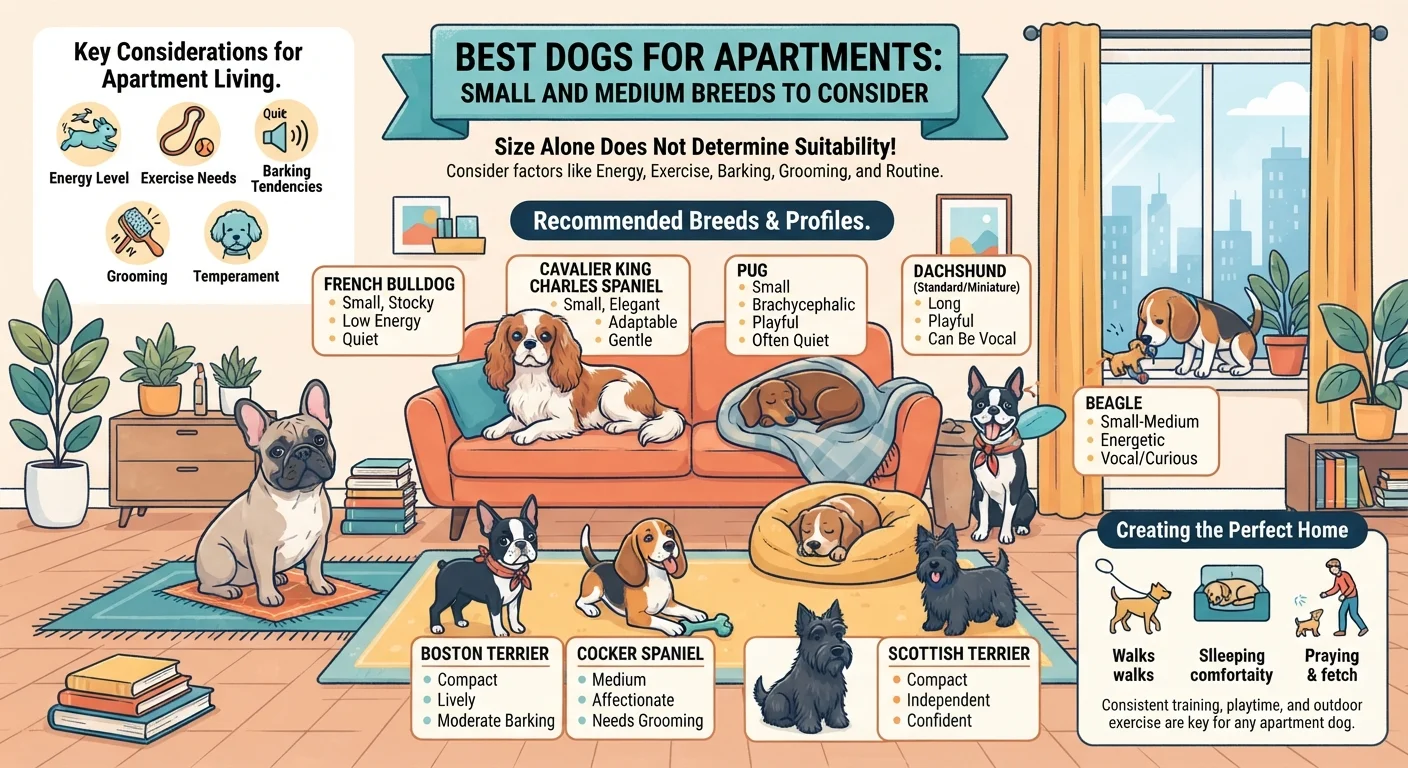
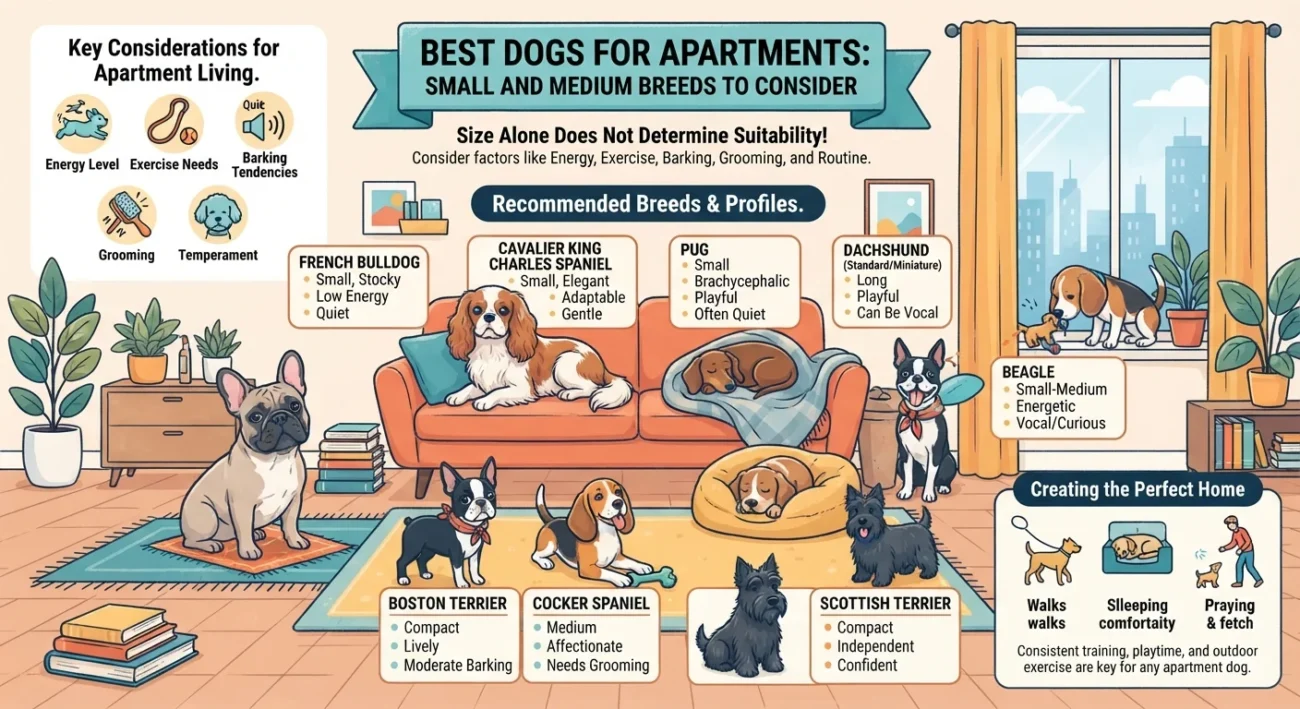
Choosing a dog for an apartment is about much more than finding the smallest breed available. A tiny dog can be highly energetic, vocal, or demanding, while a larger dog may be surprisingly calm and adaptable. The best apartment dogs are usually those whose energy level, exercise requirements, temperament, barking habits, grooming needs, and daily routine fit comfortably with the owner’s lifestyle and the limitations of the home.
Living in an apartment does not mean you cannot have a happy, healthy dog. Many small and medium-sized breeds can thrive in apartments when their physical and mental needs are properly met. What matters most is understanding what the individual dog needs and whether you can consistently provide it.
For some people, the ideal companion may be a relaxed small breed that enjoys short walks and plenty of time indoors. For others, a medium-sized dog with moderate energy may be a better match. Some dogs are content to sleep while their owner works, while others need several hours of activity and interaction every day.
This guide explores the best dogs for apartments, including small and medium breeds worth considering. It also explains how to evaluate energy, exercise, barking, size, grooming, temperament, and your own daily routine before choosing a dog.
read more about dogs for sale
What Makes a Dog Suitable for Apartment Living?
Apartment suitability is not determined by weight or height alone. A dog’s overall lifestyle requirements are much more important.
Energy Level Matters More Than Size
One of the biggest misconceptions about apartment dogs is that smaller automatically means easier.
A small dog can have enormous energy and require extensive exercise. Some compact breeds were historically developed for hunting, herding, or other demanding jobs and may become restless without enough physical and mental stimulation.
At the same time, some larger dogs are relatively calm indoors. They may enjoy a daily walk and then spend much of the day relaxing.
When evaluating the best apartment dogs, ask how much activity the breed generally needs rather than simply asking how large it will become.
Exercise Requirements Should Match Your Lifestyle
Every dog needs regular physical activity, but the amount varies significantly.
A dog that requires several hours of vigorous activity every day may struggle if its owner works long hours and prefers a quiet lifestyle. Another dog may be perfectly comfortable with a couple of walks, indoor play, and mental stimulation.
Before adopting or purchasing a dog, honestly consider how much time you can devote to exercise every day.
Barking Can Be Important in Apartments
Noise is one of the most important considerations when choosing a dog for an apartment.
In a detached house, occasional barking may not bother neighbors as much. In an apartment building, sound can travel through walls, doors, hallways, and ceilings.
Some breeds are naturally more vocal than others, although individual personality and training also play major roles.
A quiet dog can be a better neighbor and may also be more comfortable for an owner who prefers a peaceful home.
Grooming Requirements Should Be Considered
A dog’s coat can affect how much time and money you spend on maintenance.
Some breeds shed heavily and require regular brushing. Others need professional grooming every few weeks. Dogs with long or curly coats may require consistent coat care to prevent mats and tangles.
Before choosing among small dogs for apartments, consider whether you have the time, budget, and willingness to maintain the breed’s coat.
Temperament Is Crucial
A dog that is relaxed and adaptable may be easier to manage in an apartment than one that becomes anxious or overstimulated easily.
Consider whether the dog is generally comfortable with visitors, elevators, hallway sounds, traffic, other dogs, and unfamiliar people.
Apartment living means the dog may regularly encounter neighbors and other animals in shared spaces.
Why Size Alone Does Not Determine the Best Apartment Dog
It is tempting to assume that a tiny dog is automatically the perfect choice for a small home. However, this can lead to poor matches.
Small Dogs Can Have Big Exercise Needs
Some small breeds were developed for active work.
They may need daily walks, games, training, and opportunities to explore. Without enough activity, they can become bored and develop unwanted behaviors.
Therefore, choosing a tiny dog simply because your apartment is small does not guarantee compatibility.
Larger Dogs Can Sometimes Adapt Well
Certain medium or even larger dogs may spend much of their time relaxing indoors if they receive adequate exercise outside the home.
The important question is not simply, “How much space does this dog occupy?” It is also, “What does this dog need every day to remain physically and mentally healthy?”
Consider Indoor Behavior
A dog that is calm inside can often adapt better to an apartment than a smaller dog that constantly runs, jumps, vocalizes, or searches for stimulation.
Indoor behavior is therefore an important part of evaluating potential breeds.
French Bulldog
French Bulldogs are frequently considered among the best dogs for apartments because of their compact size, affectionate nature, and generally moderate exercise requirements.
Personality
French Bulldogs are often social, affectionate, and strongly attached to their people.
They can enjoy relaxing at home and participating in everyday family activities without needing enormous amounts of space.
Their playful personalities can make them entertaining companions, while their relatively compact bodies make them practical for many apartments.
Exercise Needs
French Bulldogs generally do not require the same level of endurance exercise as highly athletic breeds.
Short walks and moderate play can provide activity, although individual dogs differ.
Because of their short facial structure, owners should be especially careful with heat and strenuous exercise. Hot weather can be particularly challenging for brachycephalic dogs.
Barking
French Bulldogs are not usually chosen because they are extremely vocal.
However, individual dogs can bark, whine, or make other noises, particularly when excited, bored, anxious, or seeking attention.
Early training and appropriate enrichment can help establish good apartment behavior.
Grooming
Their short coat is relatively simple to maintain, although regular brushing can help remove loose hair.
Owners should also pay attention to skin folds, ears, nails, and general hygiene.
Cavalier King Charles Spaniel
The Cavalier King Charles Spaniel can be an excellent choice for people looking for an affectionate small companion.
Personality
Cavaliers are known for their friendly and affectionate temperament.
They often enjoy spending time with their owners and can adapt well to indoor life when their exercise and companionship needs are met.
Their people-oriented nature can make them wonderful companions for individuals and families.
Exercise Needs
Although Cavaliers are small, they are not completely sedentary.
They generally benefit from daily walks and opportunities to play and explore. Their exercise needs can often be accommodated by an owner who is willing to maintain a consistent routine.
Social Needs
This breed can become strongly attached to its family.
Potential owners should consider how much time the dog will spend alone. A dog that struggles with being alone may require additional planning, training, and enrichment.
Grooming
Their longer coat requires more maintenance than a short-haired breed.
Regular brushing can help prevent tangles and keep the coat in good condition.
Pug
Pugs are another small breed that can adapt to apartment environments.
Personality
Pugs are typically companion-oriented and enjoy being close to their owners.
They often have playful, humorous personalities and can be happy spending considerable time indoors.
Exercise Needs
Pugs usually benefit from regular moderate activity rather than intense endurance exercise.
Short walks and indoor play can provide useful activity.
As with other short-faced breeds, owners need to be cautious about heat and excessive exertion.
Apartment Behavior
Their compact size and tendency to enjoy indoor companionship can make them practical for apartment living.
However, Pugs can sometimes snore, make unusual breathing sounds, or shed more than prospective owners expect.
Grooming
Their short coat is easy to brush, but Pugs can shed significantly.
Regular grooming and attention to skin folds are important parts of responsible care.
Boston Terrier
The Boston Terrier is a compact breed with a lively but often manageable personality.
Personality
Boston Terriers are generally intelligent, playful, and people-oriented.
They can be entertaining companions without requiring a huge living space.
Exercise
They benefit from daily walks and play.
Their activity requirements can often be accommodated by apartment residents who are willing to provide regular outdoor exercise and indoor enrichment.
Barking
Boston Terriers are not necessarily among the most persistent barkers, but individual dogs vary.
Training from an early age can help prevent nuisance barking and teach appropriate responses to sounds in hallways or outside the apartment.
Grooming
Their short coat requires relatively little maintenance compared with long-haired breeds.
This can be an advantage for owners who want a simpler grooming routine.
read more about puppies for sale
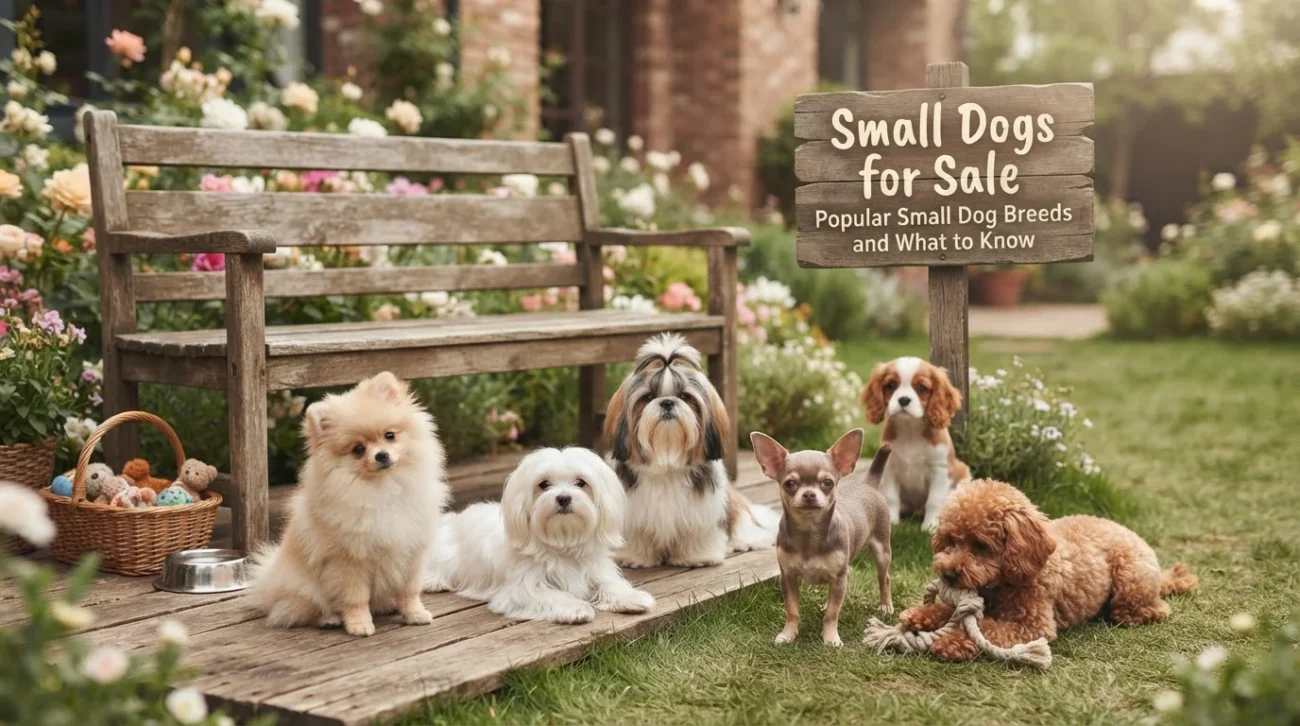
Shih Tzu
Shih Tzus are small companion dogs that can work well for many apartment lifestyles.
Personality
Shih Tzus were developed primarily as companion dogs and often enjoy spending time with their people.
They can be playful but are generally suited to indoor companionship when their exercise and enrichment needs are met.
Exercise Needs
They usually do not require extremely long exercise sessions.
Short walks and indoor play can contribute to their daily activity.
However, low exercise requirements should never be interpreted as no exercise requirements. Every dog needs opportunities to move, explore, and interact with its environment.
Grooming
Grooming is one of the biggest considerations with a Shih Tzu.
A longer coat requires regular brushing and maintenance. Owners who prefer a lower-maintenance appearance may choose a shorter haircut, but professional grooming may still be necessary.
Barking
Some Shih Tzus can be alert and vocal.
Training, socialization, and appropriate mental stimulation can help manage unnecessary barking.
Havanese
The Havanese is a small companion breed that can be well suited to apartment life for owners who enjoy an affectionate and social dog.
Personality
Havanese are often described as friendly, playful, and strongly people-oriented.
They can enjoy games and interaction while also spending time relaxing with their families.
Exercise
Their exercise needs are generally manageable for apartment residents.
Daily walks, play sessions, and training games can help keep them mentally and physically engaged.
Socialization
Because they are social dogs, early exposure to different people, environments, sounds, and experiences can help them become confident adults.
This is particularly useful in apartment buildings where dogs encounter elevators, doors, neighbors, visitors, and other pets.
Grooming
Their coat requires regular attention.
Potential owners should be prepared for brushing and routine grooming rather than assuming that a small dog automatically requires little maintenance.
Maltese
The Maltese is another small companion breed often considered by apartment residents.
Personality
Maltese dogs can be affectionate, lively, and strongly connected to their owners.
Their small size makes them convenient for many homes, but their emotional and behavioral needs still require attention.
Exercise
They can usually obtain adequate activity through short walks, play, and indoor interaction.
Because they are small, games inside the apartment can contribute meaningfully to their daily activity.
Barking
Some Maltese dogs can become vocal, particularly when they hear unfamiliar noises or want attention.
This makes early training particularly valuable in apartments.
Owners should teach the dog appropriate responses to sounds from hallways, elevators, doors, and neighboring apartments.
Grooming
Their coat can require significant maintenance if kept long.
Regular brushing and professional grooming may be necessary.
Bichon Frise
The Bichon Frise is a small, cheerful companion breed that can adapt well to apartment environments.
Personality
Bichons are often playful, affectionate, and sociable.
Their small bodies make them practical for limited spaces, while their personalities can provide plenty of companionship.
Exercise
They still need daily activity.
Walks, games, and training sessions can help satisfy their physical and mental needs.
Mental Stimulation
Bichons can benefit from learning tricks, playing interactive games, and participating in simple training activities.
Mental stimulation is particularly important for apartment dogs because indoor environments can become repetitive if the dog receives little variety.
Grooming
The coat requires regular care.
Owners should understand the grooming commitment before choosing this breed, especially if they prefer a consistently maintained coat.
Miniature Poodle
The Miniature Poodle is a small breed that can be highly adaptable to apartment life when its mental and physical needs are met.
Intelligence
Poodles are known for being intelligent and trainable.
This can be a major advantage for apartment living because training can help establish appropriate behavior in a relatively confined environment.
Exercise Needs
Miniature Poodles are not simply decorative indoor dogs.
They generally benefit from daily physical activity and mental challenges.
Walks, training, puzzle toys, and interactive games can help keep them satisfied.
Mental Stimulation
Because of their intelligence, they may become bored if their lives lack variety.
An owner should be prepared to provide activities that require thinking as well as physical movement.
Grooming
The coat requires regular maintenance.
Professional grooming may be necessary depending on the desired haircut and coat length.
Toy Poodle
Toy Poodles can be appealing to people searching for dogs for small homes because of their tiny size and intelligence.
Personality
Toy Poodles can be lively, affectionate, and highly responsive to training.
Their small bodies make them easy to accommodate physically, but their brains still require stimulation.
Exercise
They can often get much of their daily activity through walks, indoor games, training, and interactive activities.
The fact that they are small does not mean that they should remain inactive.
Training
Training can be especially useful with Toy Poodles because it gives them mental work and helps establish good household manners.
Teaching commands, tricks, appropriate barking behavior, and calmness can improve the apartment experience for both dog and owner.
Grooming
Their curly coat requires regular care.
Potential owners should consider grooming expenses when calculating the long-term cost of keeping the breed.
Yorkshire Terrier
The Yorkshire Terrier is a tiny breed that can be convenient for apartment living.
Personality
Yorkies are small but can have confident and energetic personalities.
They often enjoy interaction and play and can form strong bonds with their owners.
Exercise
Their small bodies mean they can obtain meaningful activity through relatively short walks and indoor play.
However, they should still receive regular opportunities to explore outside.
Barking
Barking can be an important consideration.
Some Yorkshire Terriers are highly alert and may react to sounds, people, or other animals.
Apartment owners should take training seriously if they want to minimize nuisance barking.
Grooming
A Yorkshire Terrier’s coat can require significant maintenance if kept long.
Regular brushing and professional grooming may be part of the routine.
Chihuahua
The Chihuahua is one of the smallest dog breeds and is frequently considered by people with limited living space.
Personality
Chihuahuas can be affectionate, alert, confident, and energetic.
Their small size makes them easy to accommodate, but their personality should not be underestimated.
Exercise
They generally need regular activity, but their small bodies mean that short walks and play can provide substantial exercise.
Mental stimulation is also important.
Barking
Vocal behavior is one of the main considerations.
Some Chihuahuas are very alert and may bark at unfamiliar people, noises, dogs, or activity outside the home.
For apartment living, early socialization and consistent training are particularly valuable.
Handling and Safety
Because they are extremely small, Chihuahuas can be physically vulnerable.
Owners should be careful around larger dogs, crowded environments, and situations where the dog could accidentally be stepped on.
Dachshund
Dachshunds are small dogs with distinctive personalities and bodies.
Personality
They can be curious, intelligent, confident, and entertaining.
Their compact size can make them practical for apartments, but they should not be viewed as effortless pets.
Exercise
Dachshunds need regular activity.
Walks and controlled play can help keep them fit and mentally engaged.
Because of their long backs, owners should also follow responsible handling practices and avoid activities that place unnecessary strain on the spine.
Barking
Some Dachshunds can be quite vocal.
Apartment residents should consider this characteristic carefully before choosing the breed.
Training
Consistent training and socialization can help establish good manners, particularly around visitors, neighbors, and other dogs.
read more about best dog breeds
Italian Greyhound
The Italian Greyhound is a small, elegant breed that can appeal to apartment residents.
Indoor Lifestyle
Italian Greyhounds can enjoy relaxing indoors and spending time with their owners.
Their compact size makes them easy to accommodate in smaller homes.
Exercise
They can have bursts of energy and enjoy running, but they also appreciate comfortable indoor rest.
A combination of safe exercise and relaxation can work well.
Sensitivity
Italian Greyhounds can be sensitive dogs.
They may benefit from gentle, consistent training rather than harsh methods.
Their delicate build also means owners should be mindful of physical safety.
Cold Weather
Their fine coat provides limited protection from cold conditions.
Depending on the climate, appropriate clothing may be necessary during outdoor walks.
Corgi
The Corgi is a medium-sized breed that demonstrates why size alone should not determine apartment suitability.
Personality
Corgis are intelligent, active, and often highly engaged with their surroundings.
They can be affectionate and entertaining but generally require more activity and mental stimulation than many small companion breeds.
Exercise Requirements
Corgis need regular exercise.
A person choosing one should be prepared for daily walks, play, training, and enrichment.
A small apartment can work if the owner provides sufficient activity outside and inside the home.
Barking
Corgis can be vocal.
This should be taken seriously in an apartment building where persistent barking can create conflicts with neighbors.
Is a Corgi Right for Every Apartment?
No.
A Corgi may be suitable for an active owner who has enough time for exercise and training, but it may be a poor choice for someone looking for a very low-energy companion.
This illustrates an important principle: apartment suitability depends on lifestyle compatibility, not just floor space.
Miniature Schnauzer
The Miniature Schnauzer is another medium-small breed worth considering.
Personality
Miniature Schnauzers are intelligent, alert, and often energetic.
They can become devoted companions and enjoy participating in family activities.
Exercise
They generally need daily physical activity.
Walks, games, and training can help meet their needs.
Mental Stimulation
Their intelligence means that mental activity matters.
Simple obedience training, puzzle toys, scent games, and interactive play can provide valuable enrichment.
Barking
Alertness can contribute to barking.
An owner should be prepared to teach the dog when alerting is appropriate and when quiet behavior is expected.
Whippet
The Whippet is a medium-sized breed that challenges the assumption that only tiny dogs belong in apartments.
Calm Indoor Behavior
Whippets are often known for enjoying comfortable indoor relaxation.
They can spend significant portions of the day resting after receiving appropriate exercise.
Exercise Needs
They still require opportunities to run and exercise.
A daily routine should include suitable physical activity rather than relying entirely on indoor space.
Apartment Considerations
For an active owner who can provide regular outdoor exercise, a Whippet may adapt surprisingly well to apartment living.
The breed’s indoor calmness can be an advantage, but its need for safe exercise should not be ignored.
How to Choose Between Different Apartment Dogs
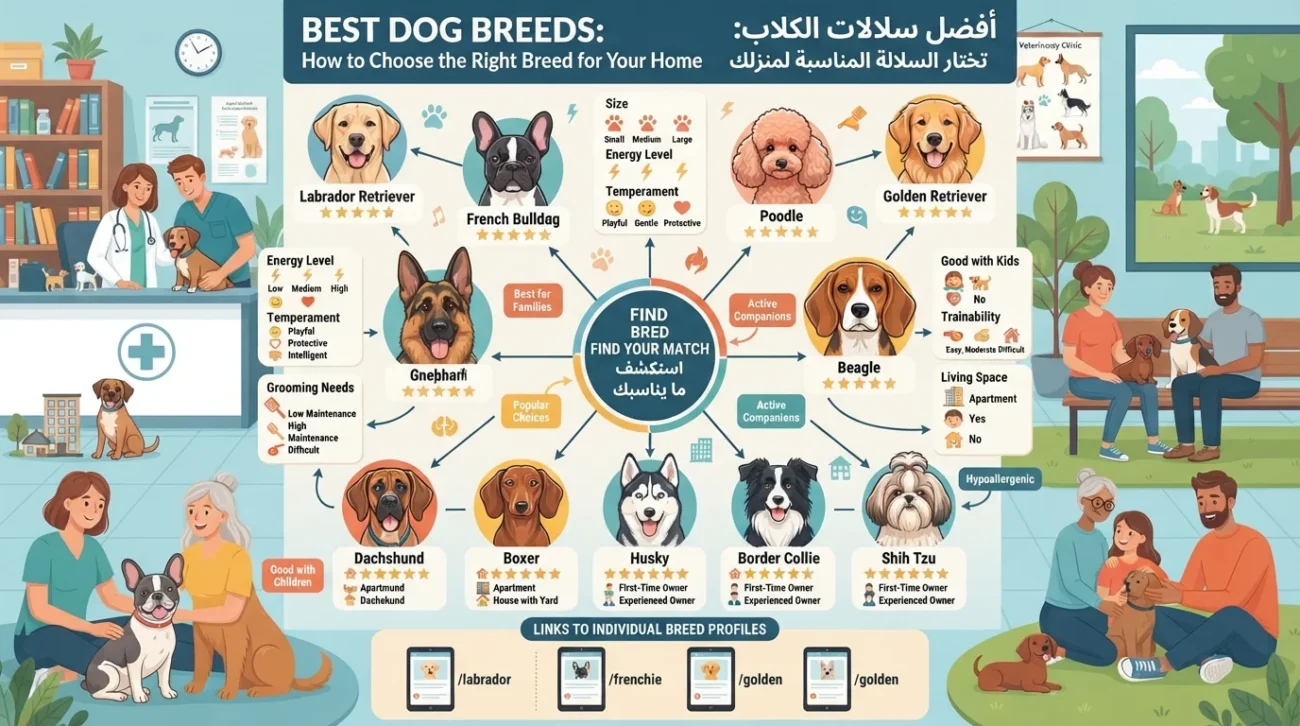
There is no universal “best” apartment breed.
Evaluate Your Daily Schedule
Start with your routine.
Ask yourself:
How many hours are you away from home?
How much time can you devote to walks?
Do you work from home?
Can you provide mental stimulation?
Do you travel frequently?
How much time can you dedicate to grooming?
Your answers may eliminate certain breeds immediately.
Consider Your Activity Level
An active person may enjoy a dog that needs longer walks and more stimulation.
Someone who prefers a quiet lifestyle may be better matched with a calmer companion.
The goal is not to choose the “easiest” dog. It is to choose a dog whose needs you can realistically meet.
Think About Your Neighbors
If you live in an apartment with thin walls or strict noise rules, barking should be a major consideration.
No breed can guarantee complete silence, and individual dogs vary.
Nevertheless, choosing a breed with a reputation for high alertness or vocal behavior may require additional training and management.
Consider Your Grooming Budget
A dog with a high-maintenance coat may require regular professional grooming.
Add these expenses to food, veterinary care, supplies, training, and other routine costs when evaluating whether a dog fits your budget.
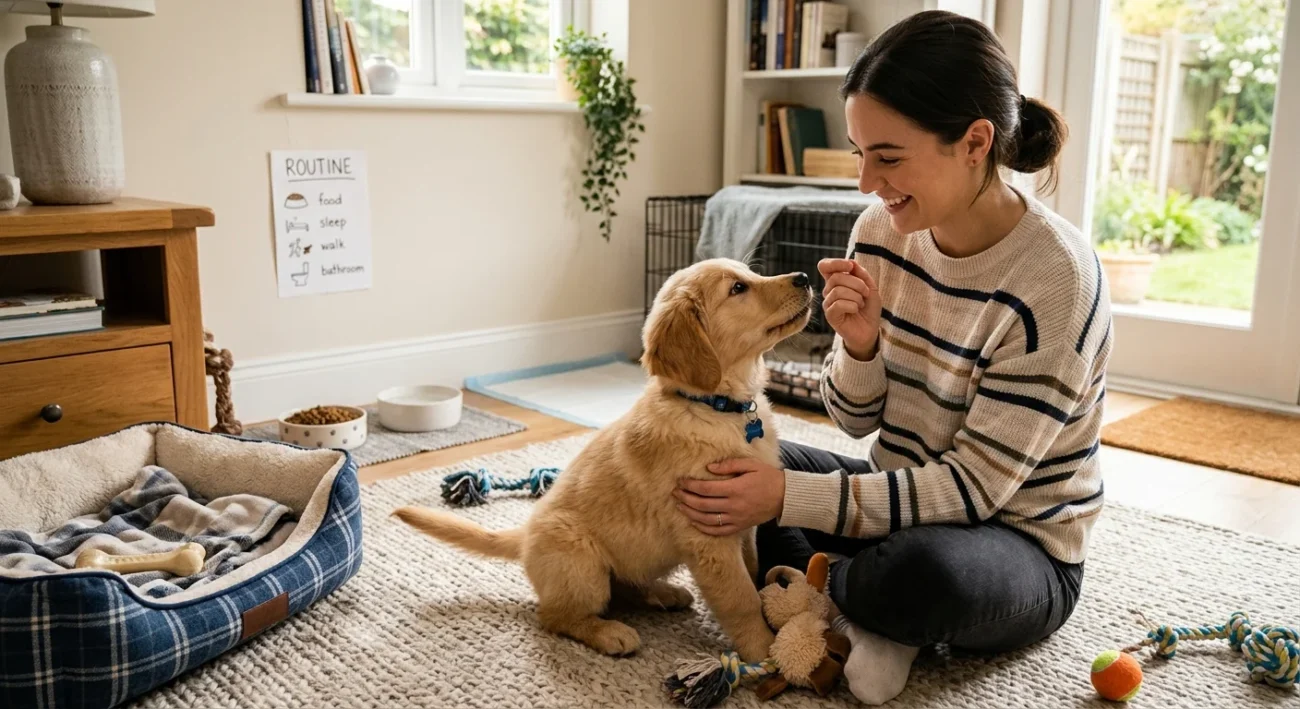
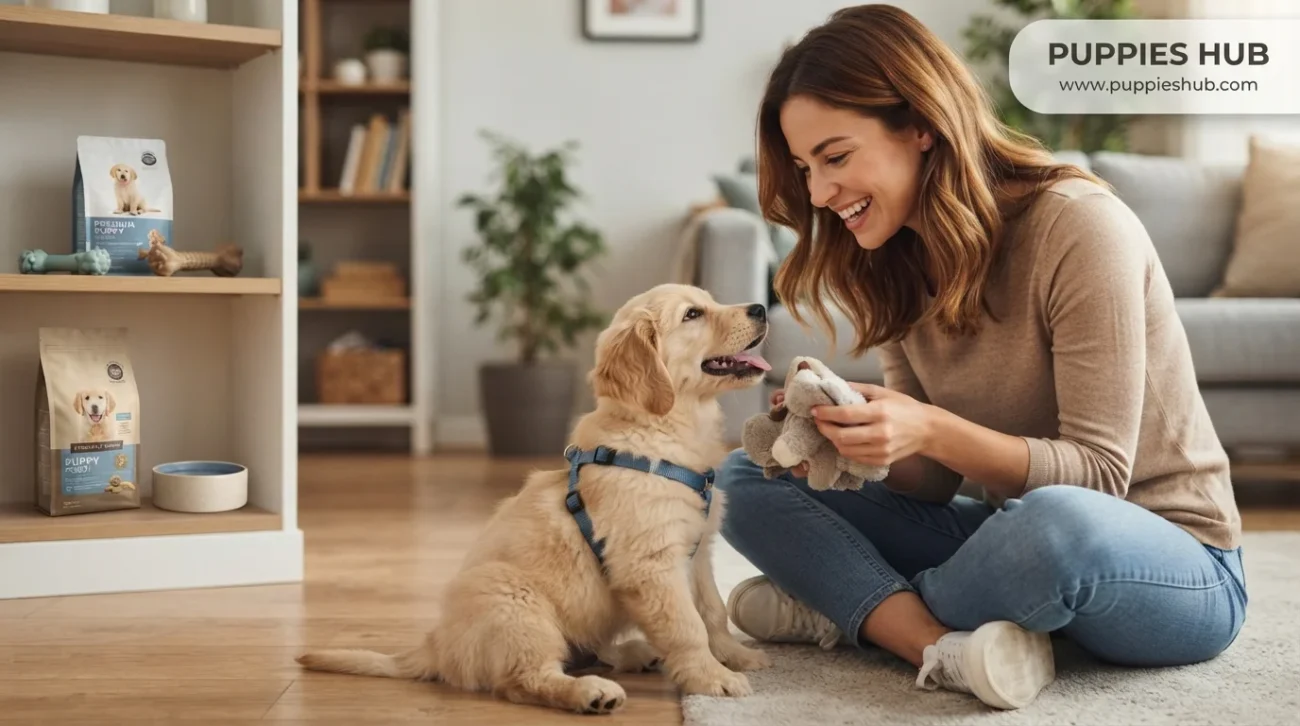
Apartment Puppies Require Extra Planning
Choosing a puppy is different from choosing an adult dog.
Puppies Need Frequent Potty Breaks
Young puppies cannot necessarily wait for long periods between bathroom breaks.
Apartment living can make potty training more challenging because reaching an outdoor area may require elevators, stairs, hallways, or longer walks.
A realistic potty-training plan is essential.
Puppies Have High Energy
Even breeds that become calm adults can be energetic as puppies.
They need play, socialization, training, exploration, rest, and supervision.
A small puppy should not be expected to remain quietly entertained in a small apartment all day.
Socialization Is Essential
Puppies benefit from safe, positive exposure to different people, sounds, environments, surfaces, and experiences.
For an apartment puppy, this can include learning to be comfortable with elevators, hallway sounds, doorbells, neighbors, traffic, and other appropriate everyday experiences.
Early socialization can help create a confident adult dog.
Adult Dogs Can Also Be Excellent Apartment Companions
Some people overlook adult dogs because they assume puppies are easier to train.
Adult Temperament Is More Predictable
With an adult dog, you may have a clearer understanding of its personality, energy level, size, and behavior.
This can make it easier to determine whether the dog matches your apartment lifestyle.
Adult Dogs May Already Have Basic Training
Some adult dogs already understand house rules and basic commands.
This does not mean every adult dog is fully trained, but an established routine can make the transition easier in some cases.
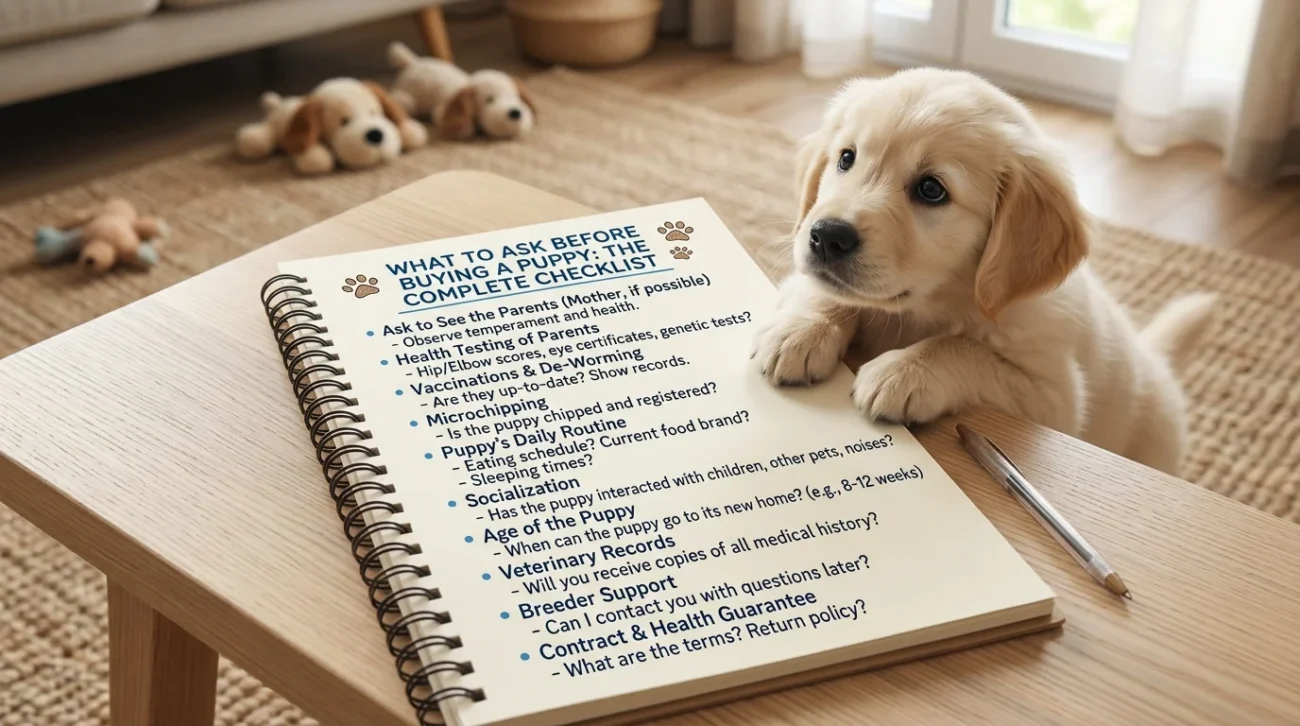
Consider Individual Dogs, Not Only Breeds
Breed tendencies are useful, but individual personality matters enormously.
Two dogs of the same breed can have very different energy levels, social needs, and barking habits.
When possible, observe the individual dog and ask detailed questions about its behavior.
Creating a Dog-Friendly Apartment
Choosing the right dog is only part of the equation.
Establish a Comfortable Resting Area
Your dog should have a quiet place where it can rest without being constantly disturbed.
A comfortable bed or crate, depending on your training approach, can give the dog a predictable personal space.
Use Vertical and Interactive Enrichment
Small apartments have limited floor space, but enrichment does not always require a large room.
Puzzle toys, training games, scent activities, and appropriate interactive toys can provide mental stimulation.
Always choose toys appropriate for your individual dog’s size and chewing habits and supervise when necessary.
Keep Dangerous Items Out of Reach
Dogs can investigate objects with their mouths.
Cleaning products, medications, electrical cords, toxic foods, and other dangerous items should be stored securely.
Puppies in particular require careful supervision because they explore almost everything.
Exercise Outside the Apartment
A small home does not have to mean a sedentary dog.
Daily Walks Provide More Than Exercise
Walks give dogs opportunities to move, sniff, observe their environment, and experience new stimuli.
For many dogs, the mental enrichment provided by a walk is just as important as physical activity.
Change Routes Occasionally
Using different safe walking routes can add variety.
New smells, sights, and environments can provide mental stimulation.
However, dogs that are nervous may need gradual exposure rather than constant novelty.
Indoor Exercise Has Limits
Indoor play can supplement outdoor activity, but it should not automatically replace walks.
Dogs need opportunities to experience the outside world.
The appropriate balance depends on the individual dog’s age, breed, health, and temperament.
Mental Stimulation for Apartment Dogs
Physical exercise is only one part of keeping a dog satisfied.
Training Sessions
Short training sessions can provide excellent mental exercise.
Teaching basic obedience, tricks, impulse control, and household manners can challenge the dog’s brain while strengthening communication between dog and owner.
Food-Based Enrichment
Appropriate food puzzles and enrichment activities can encourage dogs to use their natural problem-solving abilities.
Meals can sometimes be incorporated into enrichment rather than always being delivered in the same way.
Owners should ensure that enrichment activities fit the dog’s dietary needs and do not result in excessive calorie intake.
Scent Games
Dogs experience the world heavily through smell.
Simple scent-based games can provide mental stimulation without requiring a large amount of physical space.
These activities can be especially useful on days when outdoor exercise is limited, although they should supplement rather than permanently replace appropriate physical activity.
Final Considerations Before Choosing an Apartment Dog
The ideal apartment dog is not defined by a particular weight, height, or breed label.
Match the Dog to the Person
A highly active person may be perfectly capable of living with an energetic dog in an apartment.
A busy person with limited time may need a calmer companion whose exercise and mental stimulation requirements better fit the available schedule.
The same apartment can therefore be an excellent home for one dog and a poor environment for another.
Think Beyond the First Year
Do not choose a dog based only on what works for your current schedule.
Dogs can live for many years, and your circumstances may change.
Consider future work schedules, travel, family responsibilities, financial commitments, and the amount of time you will realistically be able to provide throughout the dog’s life.
Consider Adoption When Appropriate
Shelters and rescue organizations can sometimes offer adult dogs whose personalities are already easier to evaluate.
If you are considering adoption, discuss your apartment environment honestly with the organization or foster caregiver.
They may be able to help identify dogs that have demonstrated suitable energy levels and household behavior.
read more about best puppies for families
The Best Dogs for Apartments Depend on the Owner
There is no single breed that deserves the title of the best apartment dog for everyone.
French Bulldogs, Cavalier King Charles Spaniels, Pugs, Boston Terriers, Shih Tzus, Havanese, Maltese, Bichon Frises, Toy and Miniature Poodles, Yorkshire Terriers, Chihuahuas, Dachshunds, Italian Greyhounds, Corgis, and Whippets can all appeal to different types of apartment residents, but each comes with its own characteristics and responsibilities.
The most important lesson is that size alone does not determine whether a dog is suitable for apartment living.
Energy level, exercise requirements, barking, temperament, grooming, social needs, training, age, and your daily routine all matter.
A small dog that never settles and barks at every hallway noise may be more difficult in an apartment than a medium-sized dog that receives sufficient exercise and spends most of the day calmly resting.
Likewise, a low-energy breed can still become unhappy if it receives no walks, interaction, training, or mental stimulation.
The best approach is to evaluate the complete picture.
Before bringing home a dog, ask whether you can provide the exercise it needs, whether you have enough time for training and companionship, whether you can manage grooming requirements, and whether its typical behavior is compatible with your building and neighbors.
When those factors align, apartment living can be an excellent environment for a dog.
A well-matched dog does not need a huge house to have a fulfilling life. It needs responsible care, appropriate exercise, mental stimulation, companionship, training, veterinary attention, and a predictable daily routine.
For that reason, the best apartment dog is ultimately the one whose needs you can consistently meet and whose personality fits the way you actually live.